
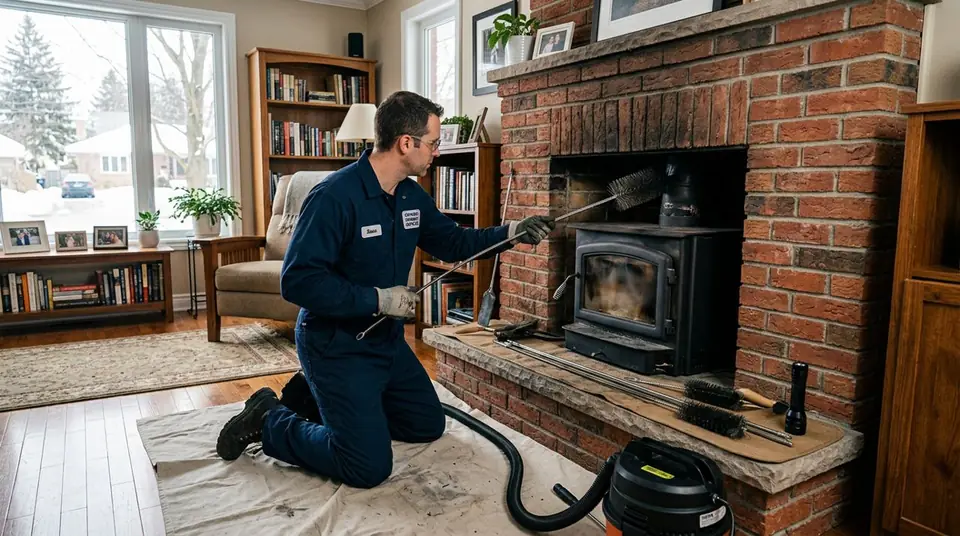
Technician performing flue cleaning at an Ontario home

Chimney Services

Flue Cleaning in Ontario

Cleaning the flue passage of soot, creosote and residue for appliances of all fuel types.

Get your quote now!

Send us the details and we will come back with availability and pricing.

Adding your address helps us confirm availability faster.

Or call (365) 360-2646 · Mon–Fri 8am–8pm · Sat–Sun 9am–5pm

Ontario, Canada
Mon–Fri 8am–8pm · Sat–Sun 9am–5pm
Quoted before any work begins
Clean, contained work in your home
Technician performing flue cleaning at an Ontario home

Cleaning the flue passage of soot, creosote and residue for appliances of all fuel types. Our flue cleaning work is carried out by technicians who deal with these systems every week across Ontario, so the diagnosis comes from experience rather than guesswork.

A chimney is a working system: the flue has to draw properly, the liner has to contain heat and combustion gases, and the exterior masonry has to keep water out. When one part fails, the rest usually follows. Our chimney work covers routine sweeping and inspection right through to relining, crown repair and full rebuilds.

Every flue cleaning visit starts with an assessment, not a sales pitch. We look at the system, tell you what we found, and quote the work before anything begins.

Flue Cleaning explained

Cleaning the flue passage of soot, creosote and residue for appliances of all fuel types. That one-line description covers what the job is, but homeowners usually want to know what actually happens, why it matters and what it will cost before they pick up the phone. This page goes through flue cleaning in detail so you can decide whether it is the right service for the problem you are seeing, and so you know what a competent visit should look like when a technician arrives at your door.

A chimney is a working system: the flue has to draw properly, the liner has to contain heat and combustion gases, and the exterior masonry has to keep water out. When one part fails, the rest usually follows. Our chimney work covers routine sweeping and inspection right through to relining, crown repair and full rebuilds. It is the reason we start with an assessment rather than a parts list.

Across Ontario we see the same equipment in very different conditions. A flue cleaning job in a 1920s brick house in an older neighbourhood is not the same as the same job in a fifteen-year-old subdivision home with a factory-built appliance. The steps overlap, but the materials, the access and the failure points differ, so the assessment always comes before the quote.

Why homeowners book flue cleaning

Some homeowners book flue cleaning as part of a yearly routine, the same way they would service a car. Others call because something changed suddenly. We handle both, but a system on a regular schedule tends to need fewer repairs and lasts noticeably longer.

There is also the paperwork side. Home sales, insurance requests and rental inspections all raise questions about heating appliances and venting, and homeowners often need a clear written record of the system's condition. We document what we see with photos and plain-language notes so you have something concrete to hand over rather than a verbal reassurance.

Cost is another driver. Equipment that is dirty, poorly adjusted or partially blocked works harder to produce the same heat. Bringing it back to a proper operating condition usually shows up on the bill over a full season.

What the visit includes

A flue cleaning appointment follows a consistent structure so nothing gets skipped when the schedule is busy. We protect the work area first, then assess, then carry out the agreed work, then test and clean up. You will be told what we found before anything is repaired or replaced, and you can ask questions at any point.

  • Visual assessment of the flue, liner, damper and firebox
  • Removal of soot, creosote and debris where applicable
  • Check of the cap, crown, flashing and exterior masonry
  • Photos and a plain-language explanation of what we found
  • Written recommendations with clear pricing before any repair work

Signs it is time to call

If you recognise more than one of the following, it is worth booking sooner rather than waiting for the next heating season.

  • Smoke rolling back into the room when the fire is lit
  • A strong campfire or tar-like smell from the fireplace
  • Dark staining, damp patches or crumbling brick around the chimney
  • Pieces of masonry, tile or debris landing in the firebox
  • Birds, squirrels or nesting sounds inside the chimney
  • You have not had the chimney inspected in more than a year

How Ontario weather affects the system

Between lake-effect snow, ice storms and temperature swings of twenty degrees in a week, Ontario homes ask a lot of their heating systems. That workload shows up first at joints, seals and any place water can sit.

Humidity plays a part as well. Summers here are humid, and moisture inside an unused flue or an idle appliance encourages corrosion and odour that only become obvious when the system is fired up again in the autumn. That is one reason a late-summer or early-autumn appointment tends to catch problems before they interrupt the heating season.

Rural and cottage properties add another layer: propane instead of natural gas, longer vent runs, more wildlife activity and buildings that sit empty for months. Those systems need the same care as a city installation, and often a bit more attention to screening and weather protection.

Safety comes first

Anything that burns fuel produces exhaust, and that exhaust has to leave the building completely and reliably. That is the underlying reason flue cleaning exists as a service. Blocked or damaged venting, failed seals and worn combustion components can allow smoke or combustion gases into living space, and those are not problems you want to discover slowly.

Because these systems are connected, we look at every stage of the run before signing off. If something outside the scope of the booked job needs attention, we will tell you and let you decide.

We also recommend working carbon monoxide alarms on every level of the home with a fuel-burning appliance, and a smoke alarm outside every sleeping area. They are inexpensive, they are required in Ontario homes with fuel-burning appliances, and they are the last line of defence if something changes between service visits.

Our process, step by step

Every flue cleaning job follows the same four stages so you always know where you stand.

  • Contact — you describe the appliance, the symptoms and the property, and we confirm what the visit will involve.
  • Assessment — we examine the system on site, take photos where it helps, and identify the actual cause rather than the obvious symptom.
  • Recommendation — you get clear options and pricing, with the difference between urgent, worthwhile and optional spelled out.
  • Work and testing — once you approve, we complete the job, test the system under normal operating conditions and clean the area.

What affects the price

Cost is set by the work in front of us, not by a script. Here is what actually moves the figure up or down for flue cleaning.

  • The type, age and condition of the equipment, and whether parts are still readily available
  • Access — a ground-floor appliance is straightforward, a steep roof or a tight basement is not
  • How much cleaning or preparation is needed before the actual work can begin
  • Whether parts are replaced with standard components or something specific to the model
  • The size and layout of the system, including the length and route of any venting
  • Whether related faults are found during the assessment that you choose to address at the same time

Repair or replace?

Sometimes the right answer is the smaller job. Plenty of appliances that homeowners assume are finished need a component and a proper clean. Others genuinely are worn out, and pretending otherwise just delays the expense.

Age alone is not a verdict. A well-built appliance that has been serviced regularly can outlast a neglected unit half its age. What matters is the condition of the parts that are expensive or impossible to replace — the heat exchanger, the firebox shell, the structure of a chimney — rather than the components that are designed to be renewed.

Either way the choice stays with you. We provide the assessment and the numbers; you decide what to spend and when.

Keeping it in good shape afterwards

The best outcome after flue cleaning is that you do not think about the system again for a year. An annual visit is what makes that realistic.

  • Have the appliance and its venting checked once a year, before the cold arrives
  • Keep the area around the appliance clear of furniture, decorations and stored items
  • Watch for changes in smell, sound, flame appearance or heat output and mention them when you book
  • Check exterior components after storms and heavy freeze-thaw periods
  • Test smoke and carbon monoxide alarms monthly and replace them at the end of their rated life
  • Keep receipts and inspection notes together — they help at resale and with insurance questions

What we look at during the assessment

A proper look takes time. We check operation, condition and clearances, and we compare what we find against how the system was meant to be installed. Where a previous repair has created a problem, we point that out rather than working around it.

We also ask questions, because the history usually explains the fault faster than the hardware does. When did it start? Has anything changed in the house — new windows, a bathroom fan, a renovation, a different fuel supplier? Changes like those alter airflow and pressure in a building, and they are behind a surprising number of draft and combustion complaints.

You finish the appointment knowing the condition of the system, the priority of each item and the price attached to it. What you do with that is entirely your call.

Parts, materials and workmanship

Good workmanship on flue cleaning shows up years later, not on the day. Correct materials, proper clearances, sealed joints and a tidy installation are what separate a repair that lasts from one that has to be revisited next winter.

Where a part is obsolete — and on older appliances that happens — we will say so up front rather than fitting an approximate substitute. Sometimes there is a proper equivalent available, sometimes there is not, and knowing which situation you are in is important before spending money on a unit that may need replacing anyway.

We work independently of any manufacturer, so nothing is recommended because of a supplier arrangement. The advice you get is based on the equipment in your home and what will hold up in this climate.

Booking and what to expect on the day

Booking flue cleaning starts with a short conversation about the appliance, the symptoms and the property — the age of the home, the fuel, and how the equipment is reached. That information lets us bring the right tools and set aside a realistic amount of time, which is why we ask rather than simply putting a slot in the calendar.

Expect the visit to begin with protection and a walkthrough. We would rather spend five minutes confirming the symptom with you than an hour chasing the wrong fault.

Timing varies with the work. A straightforward clean or service is usually a couple of hours; diagnostics on an intermittent fault take longer; masonry and installation work can run across more than one visit. We will give you a realistic window when the appointment is booked and let you know if anything on site changes it. Serving homes throughout ontario, canada, (365) 360-2646 is the fastest way to get a date confirmed.

Why work with us

We keep the process simple: turn up when we said we would, look at the system properly, explain what we found in language that makes sense, and quote before we start.

We work in occupied homes, so containment and cleanup are part of the job rather than an afterthought. Floors get covered, vacuums with proper filtration handle the dust, and the room is left as we found it. When we leave, the only difference should be that the flue cleaning work is finished.

Booking is straightforward. Send the quote form on this page or call (365) 360-2646 and describe the appliance and what it is doing. We will confirm what the visit involves, roughly how long it takes and what it will cost, then find a time that fits around your week.

What the service includes

  • Visual assessment of the flue, liner, damper and firebox
  • Removal of soot, creosote and debris where applicable
  • Check of the cap, crown, flashing and exterior masonry
  • Photos and a plain-language explanation of what we found
  • Written recommendations with clear pricing before any repair work

Signs you may need this

  • Smoke rolling back into the room when the fire is lit
  • A strong campfire or tar-like smell from the fireplace
  • Dark staining, damp patches or crumbling brick around the chimney
  • Pieces of masonry, tile or debris landing in the firebox
  • Birds, squirrels or nesting sounds inside the chimney
  • You have not had the chimney inspected in more than a year

How the visit works

01

Contact us

Send a request or call. Tell us the appliance and what it is doing.

02

Inspection or assessment

We look at the system on site and confirm the real cause.

03

Recommended solution

You get clear options and pricing before anything begins.

04

Service or repair

We complete the work, test it and leave the space clean.

Related services

Brands we service

Available across Ontario

FAQs

Flue Cleaning questions

Book flue cleaning today

Tell us what the system is doing and we will confirm the visit, the timing and the cost.

(365) 360-2646